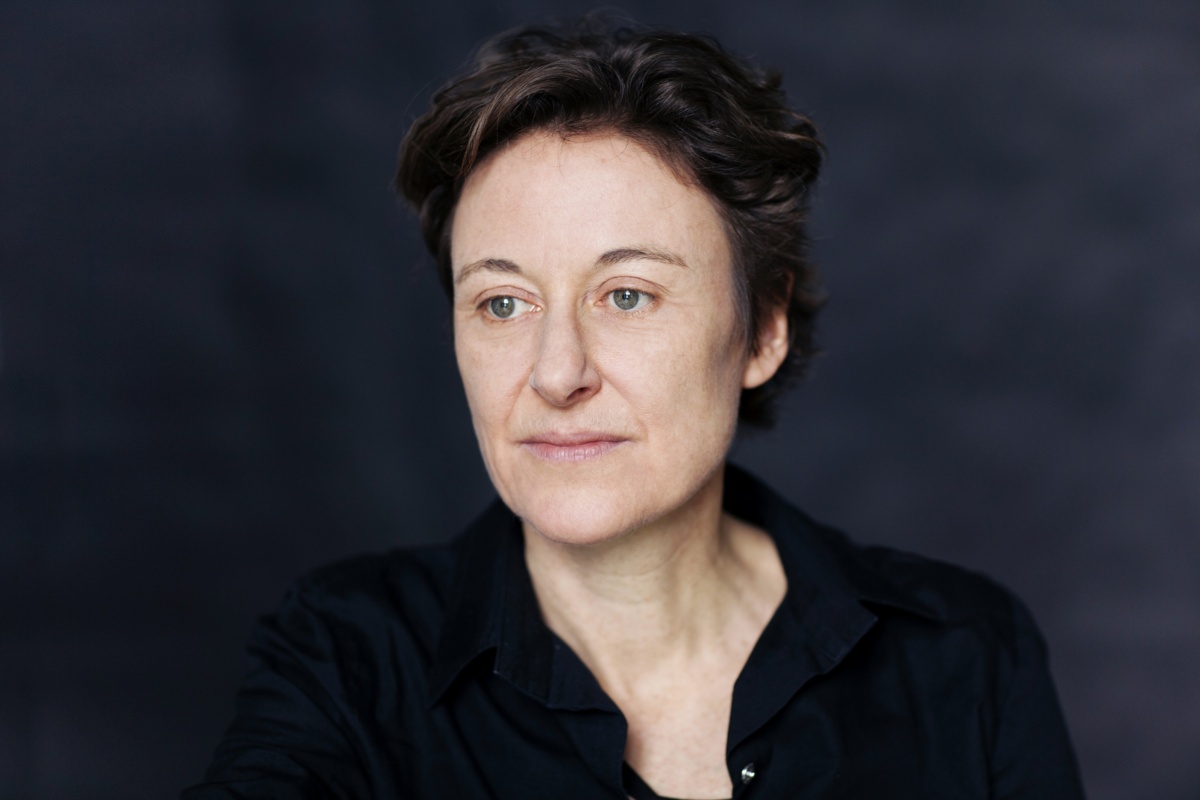
In preparation for her new work for mezzo-soprano, ensemble and electronics, Isabel Mundry has worked several times at IRCAM in Paris. Following its world premiere in Witten, Klangforum Wien, conducted by Elena Schwarz, and the soprano Hélène Fauchère will perform The I's at the Wiener Konzerthaus on 4 May, followed by the French premiere with the Ensemble intercontemporain, conducted by Pierre Bleuse, on 5 June at the Philharmonie de Paris.
In a detailed commentary on the work, Isabel Mundry describes the ideas behind her composition The I's:
"A tension runs through the work: between the self and the collective, whereby one always acts
within the other. We all know how collectives – past, present or imagined future ones – inhabit us
and our bodies. We know their threatening nature, but also the shelter they can provide. And we
know the dread that arises when individuals form uniform masses, as well as the experience of
resonance when plurality arises within groups. The piece is a meditation on such phenomena.
They all exist – presumably always have – in music as well.
Two semicircles and two centralised places envelope the audience. One consists of an
ensemble and a singer on stage, the other of loudspeakers in the hall with one distinguished
among them, which mirrors the voice.
The sound sources for the electronics are primarily historical recordings of crowds at
demonstrations or speeches in public places. These are recordings of events that involve the
expression of power by one group over another or, conversely, collective resistance to the
exercise of power by others. Some events are also ambivalent, in that one later turned into the
other. I noticed how strongly the loudness of such historical moments adheres to the body's
memory. And how di?erent the “sound” of crowds can be, depending on whether it is a
demonstration of power or an articulation of a state of oppression.
My music interweaves with these sounds and vocalisations, approaching or distancing itself
from them from di?erent perspectives. It does not seek to frame anything in any certain light.
Rather, it examines how such acoustic traces linger and connect with my inner ear.
Elsewhere in the work, recordings of empty public spaces, indoors or outdoors, fade in: places
of standstill and potential transition.
The sung text stands alongside the recordings rather than doubling or commenting on their
meaning. It expresses an antidote: the vision of a di?erent form of coming together. This makes it
both powerful and fragile. It consists of the words of Moroccan artist M'Barek Bouhichichi,
articulated through his work group ‘The Silent Mirror’ (2021). I have used this text before in
another piece, at that time in fragments. This time it is heard almost in its entirety. It is an
exploration over time.
I suspect that visions or utopias only arise where there is a severe deficiency or where violence
is felt or experienced. Visions are also concepts, as in the work of Éduard Glissant, for example,
whose writings also accompany my work. His concept of archipelagic thinking is related to the
formulations of M'Barek Bouhichichi.
My composition unfolds along perceptions that provoke visions."
Isabel Mundry
“I am drawn to those suspended places where social constraints have yet to take hold. These non-places where history dissolves and the gaze can wander freely. Like in a Spanish hostel [a self-catering establishment], where everything brought along by one person or another is, so to speak, ‘pooled’ for the benefit of all. Only in a parallel context, I believe, could a transformation be possible and repeatable. And we will know how to transition from one reality to another.”
M'Barek Bouhichichi