“I’m interested in whether it’s possible to build a bridge between the power of pop music, the directness of the performing arts, and the aesthetics and quality of new music.”
— Sara Glojnarić
SONGS FOR THE END OF THE WORLD
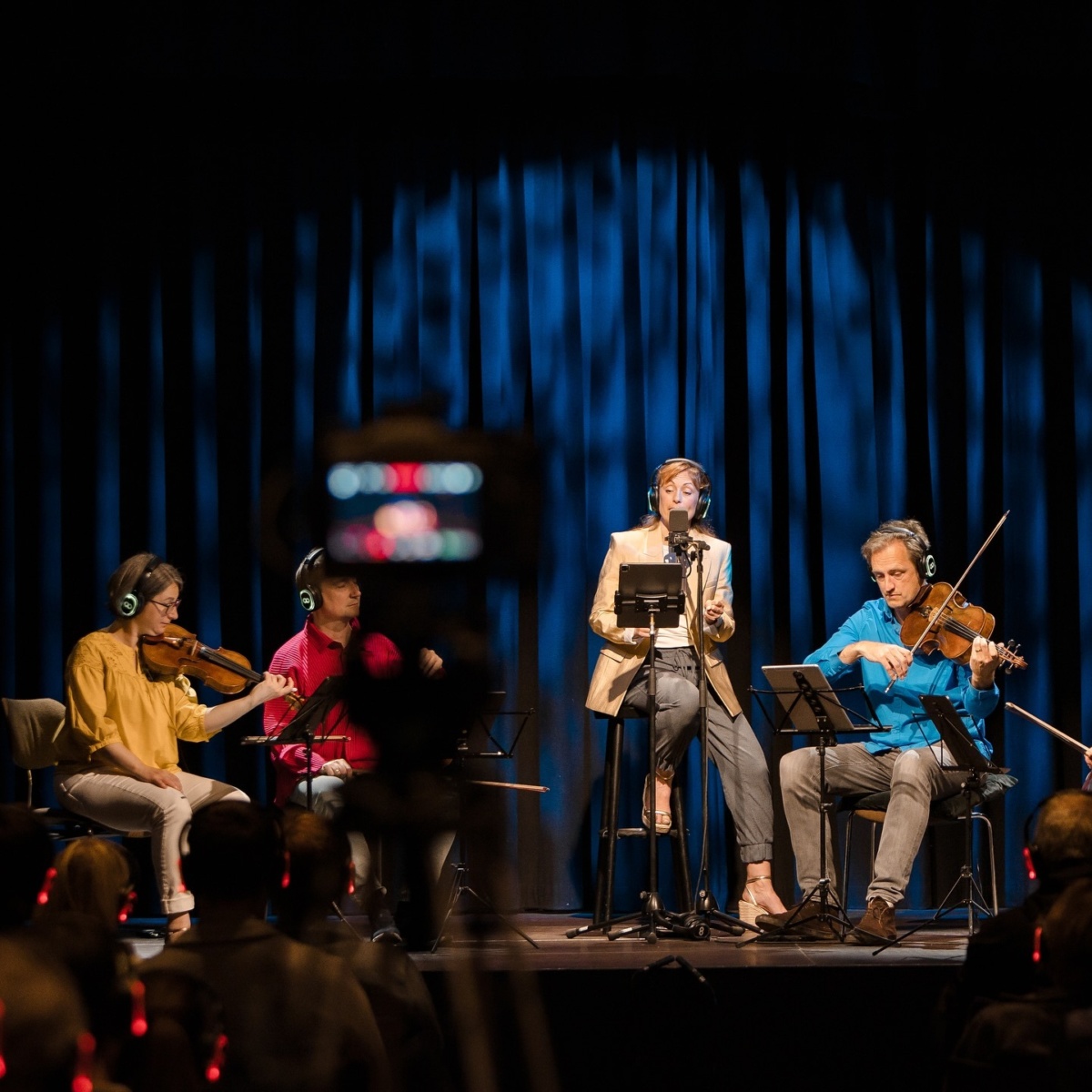
A headphone concert for soprano, string quartet & electronics
Concept
On the night of 14 to 15 April 1912, the RMS Titanic struck an iceberg. According to the stories, the ocean liner’s band kept playing until the ship went down. All of the musicians died. To this day, legends surround the band: did they really play to the very end, and what was their last song?
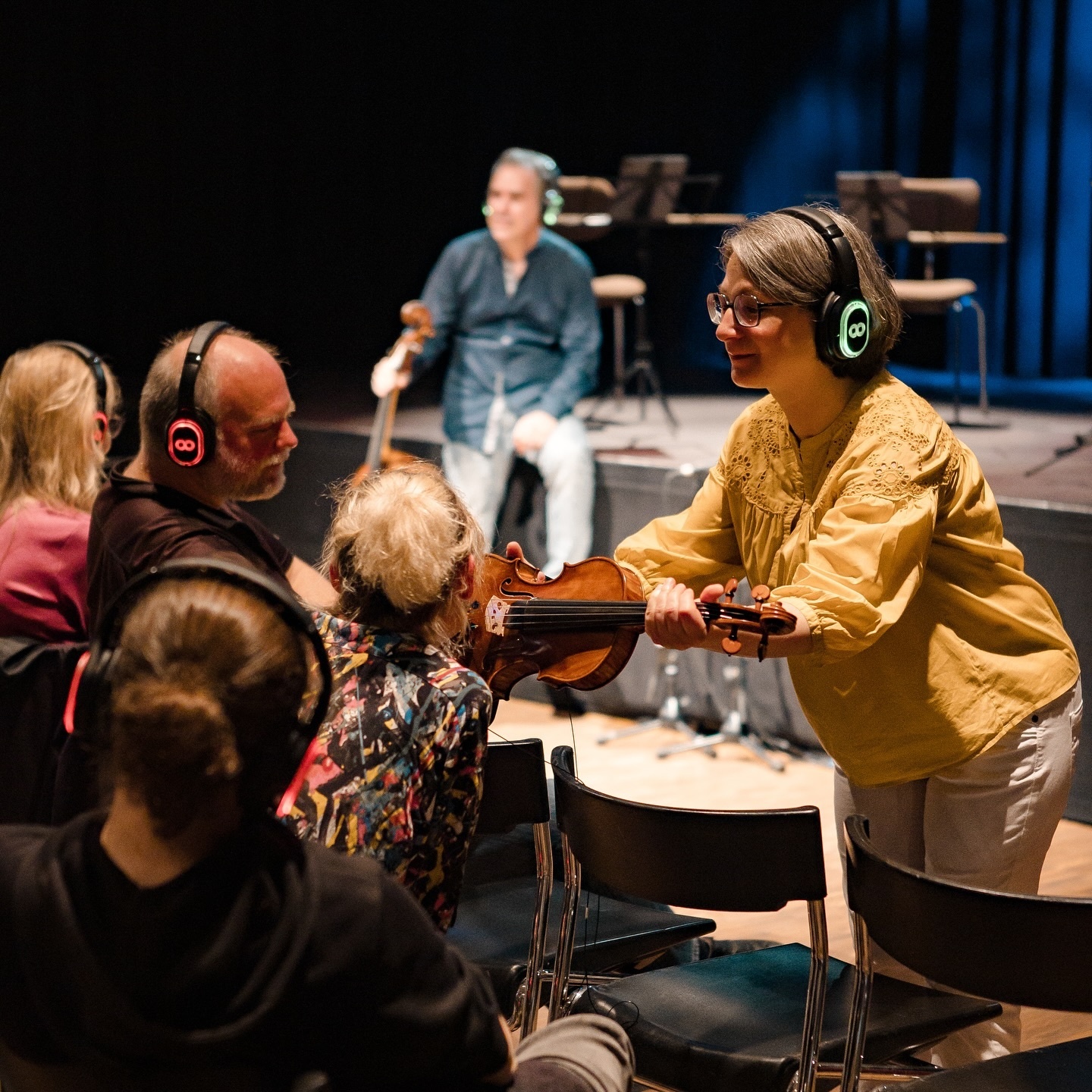
"Songs for the End of the World" is a headphone concert in the form of an experimental podcast. It takes the fascination with the Titanic disaster and the myth surrounding its band as a starting point to explore the meaning of music in dark times. What is music for survival, or for the end? What would your music for the end of the world be?
Photo credit: Wittener Tage für neue Kammermusik 2025 © WDR / Claus Langer
Programme
Sara Glojnarić
"Songs for the End of the World" for string quartet, voice, DigitAize sensors and wireless headphones
Cast
Kuss Quartet
Jana Kuss, violin
Oliver Wille, violin
William Coleman, viola
Mikayel Hakhnazaryan, violoncello
Chamber music is elevated to great, existential art by the Kuss Quartet. Radio Bremen Zwei, "Klassikwelt", December 2024
Everything remains different – constant change is the only certainty of our time. This is exactly where the Kuss Quartet comes in: with courage and a passion for discovery, it initiates new programs and formats, transforming contemporary themes into art. The quartet draws its strength equally from a spirit of experimentation and a devotion to the classical repertoire from Haydn to Schubert. In doing so, it captivates both traditional and innovation-loving audiences, opening ears to the unknown. The Kuss Quartet thus stands for both: innovation and tradition – and both in excellence.
Sarah Maria Sun
Sarah Maria Sun first gained international recognition as a performer of contemporary music. Today her repertoire spans more than 2,000 works from the 16th to the 21st century, and she has taken part in more than 400 world premieres. In recent years she has increasingly performed monodramas centred on complex female characters. She was nominated as Singer of the Year for her performances in the dual role of Elsa/Lohengrin in Salvatore Sciarrino’s "Lohengrin" (Salzburg Easter Festival) and as Gwen in Philip Venables’ "4.48 Psychosis" (Semper Zwei, Dresden).
As a soloist she has appeared at concert halls and festivals including Suntory Hall in Tokyo, the Muziekgebouw in Amsterdam, the Elbphilharmonie Hamburg, the Tonhalle Zürich, the Auditorio Nacional in Madrid, the Berlin and Cologne Philharmonie, the Paris, Venice and Munich Biennales, and the Arnold Schönberg Center in Vienna. Her festival appearances include Lucerne, Salzburg, Witten, Donaueschingen, Herrenhausen, the Festival Cervantino and the Vertice Festival in Mexico, among many others. She has been a guest at the opera houses of Zurich, Berlin, Basel, Dresden, Frankfurt, Munich, Düsseldorf, Stuttgart, Mannheim, Leipzig, Strasbourg, Luxembourg and Zagreb, as well as at the Opéra Bastille and the Opéra Comique in Paris.
Sarah Maria Sun has performed with conductors such as François-Xavier Roth, Sir Simon Rattle, Ingo Metzmacher, Sylvain Cambreling, Kent Nagano, Alan Gilbert, Thomas Hengelbrock, Susanna Mälkki, Peter Rundel and Heinz Holliger. The orchestras she has worked with include the Gewandhausorchester Leipzig, the Berliner Philharmoniker, the NDR, BR, SWR and WDR symphony orchestras, the Dresdner Philharmonie, and the Antwerp and Tokyo Symphony Orchestras. Among the ensembles are Klangforum Wien, Ensemble Musikfabrik, Ensemble Modern, Ensemble Mosaik and Ensemble intercontemporain. She has also appeared with string quartets including the Kuss Quartet, Quatuor Diotima, the Arditti Quartet, the Schumann Quartet and the Signum Quartet, among many others. From 2007 to 2014 she was first soprano of the Neue Vocalsolisten Stuttgart, a seven-voice chamber ensemble that has been one of the world’s leading pioneers of contemporary music for decades.
Since 2013 she has performed in a song duo with pianist Jan Philip Schulze. Together with clarinettist Kilian Herold, they founded the trio “Silence is Golden”.
Her discography comprises more than 40 CDs, many of which have won or been nominated for awards. She regularly gives master classes in 20th- and 21st-century vocal music at universities and conservatories in Oslo, Harvard, Chicago, Salzburg (Mozarteum), Munich, Stockholm, Zurich, Lucerne, Rostock, Moscow, Dresden, Hannover and Berlin, among others. From 2018 to 2022 she was a visiting professor, tutor and lecturer at the music universities of Hannover, Graz and Lucerne. Since 2022 she has been Professor for Creative Interpretation of New Music at the Hochschule für Musik Basel.
Hauptmeier/Recker, sound direction
Paul Hauptmeier and Martin Recker are composers working in composition, sound and multimedia art. Since 2009 they have worked together as the artist duo Hauptmeier | Recker.
They studied composition with Robin Minard and Maximilian Marcoll at the University of Music Franz Liszt Weimar. Hauptmeier also studied at UC San Diego with Katharina Rosenberger and Natacha Diels, and Recker at the Sibelius Academy in Helsinki with Marianne Decoster-Taivalkoski.
The duo works internationally across a wide range of formats. Their practice includes live electronic performances in 3D audio, large-scale and often site-specific sound installations, compositions for theatre and opera, and projects in radio art and electroacoustic composition.
As co-founders and board members of ZiMMT (Centre for Immersive Music and Media Art), they curate events and conduct research in spatial audio (www.zimmt.net).
From 2022 to 2025 they held a permanent teaching position in sound art at Burg Giebichenstein University of Art and Design Halle. They have also led composition seminars and master classes at institutions including HMT Leipzig, HfMT Cologne and the Conservatoire de musique de Montréal.
Their works have been presented at international festivals and institutions such as the Sharjah Biennial, the Istanbul Biennial, the Venice Biennale, the Biennale Musica in Venice, Festspielhaus Hellerau, Ses Dotze Naus in Ibiza, Tallinn Music Week, the European Media Art Festival and Telliskivi in Tallinn, among many others.
In 2026 they received the Thomas Seelig Prize for their musical work.
Miriam Götz, dramaturgy
Miriam Götz is a director of music theatre and drama. Her directing work focuses on contemporary music theatre and on productions for young audiences. Through collaborative processes she creates world premieres of music theatre works in the field of new music. Examples include her collaboration with composer Clemens K. Thomas and the staged family concert A Song of Salt and Water with Ensemble Recherche.
In 2023 she directed the world premiere of Sara Glojnarić’s opera Neuro-Moon. Manage your memories. (text: Emma Braslavsky). Beyond the main stage, the production also turned the studio stage into an interactive installation. At the Neuköllner Oper Berlin she directed the world premiere of Andys Skordis and Jelena Vuksanović’s chamber opera A light blue day, which won first prize at the Berlin Opera Prize.
Miriam Götz studied cultural studies and aesthetic practice in Hildesheim and musicology in Aix-en-Provence. She worked as an assistant director at the Neuköllner Oper Berlin, at the ECLAT Festival for New Music and, for several years, as a permanent member of staff at Theater Freiburg. There she worked with Matthias Rebstock, Florentine Klepper, Barbara Mundel, Calixto Bieito, Joan Anton Rechi and Ingo Kerkhof, among others. She has also collaborated with Ensemble Recherche, the Neue Vocalsolisten, the Neuköllner Oper Berlin, Opera Factory Freiburg and Theater Freiburg.